Fundamentals Photoshop in 2026
Adobe Photoshop is the world’s most popular raster graphics editor developed by Adobe Inc. It is used for digital art, photo editing, graphic design, web design, and so on and is available on Windows, macOS, and mobile devices.
From the Birth of Earth to the Digital Age
The Birth of Earth—Where Creation Began
In the beginning, screens glowed and pixels dwelt; the Earth was born out of chaos. Around 5.4 billion years ago, fire, dust, air, and gravity mixed to create our earth and planet. Rocks cooled, seas formed, and light began across landscapes. This was the first canvas—raw, unfiltered, and powerful.
Chaos, Light, and the First Canvas
The Earth didn’t want tools to look most beautiful. Light, shadow, texture, and color already existed naturally. Mountains and hills rose like bold brushstrokes, oceans and seas reflected light brighter like polished glass, and sunsets blended colors better than any gradient tool ever could. Earth is most beautiful.

Nature as the Original Designer
Nature mastered and showed and taught us contrast, balance, and harmony long before humans named these principles. Every Photoshop rule you learn today—composition, color balance, depth—was already written into the planet and earth itself.

Human Creativity Through the Ages
As humans evolved, they felt the urge to capture what they saw.
Cave Paintings and Primitive Visual Storytelling
45,000–40,000 years ago, in the time of the Upper Paleolithic period. Humans drew and painted on cave rocks using coal or charcoal and carbon minerals. The goal was simple: communicate ideas through art and images.
-
Express symbolic thinking and creativity
-
Record animals, hunting scenes, and beliefs
-
Communicate shared stories or spiritual ideas
The charcoal is the first brush, and the painting area is the first layer.
The Evolution of Art Tools
From Stones to Brushes
Over time, tools improved. Stones became brushes, pigments became paints, and creativity found new freedom.
From Canvas to Screens
Fast forward thousands of years, and the canvas transformed into screens. Art went digital—and everything changed.
The Digital Revolution
The invention of computers reshaped creativity forever and ever now also.
The Birth of Computers
When computers entered homes, creativity gained speed. Editing no longer meant starting over. Mistakes became reversible.
Pixels—The New Building Blocks of Art
Pixels replaced paint. Tiny squares of color formed images, just like atoms form matter. Photoshop was born to control these pixels.
| “Pixel” means “picture element,” the smallest single point or dot of color that made the image or photo or display. |
Fundamentals Photoshop in 2026
The blog gives more details about pixels later.
The Rise of Adobe Photoshop
Why Photoshop Changed Everything
Photoshop gave creators godlike control over images. You could bend reality, enhance beauty, and tell stories visually—without limits.
Photoshop 2026
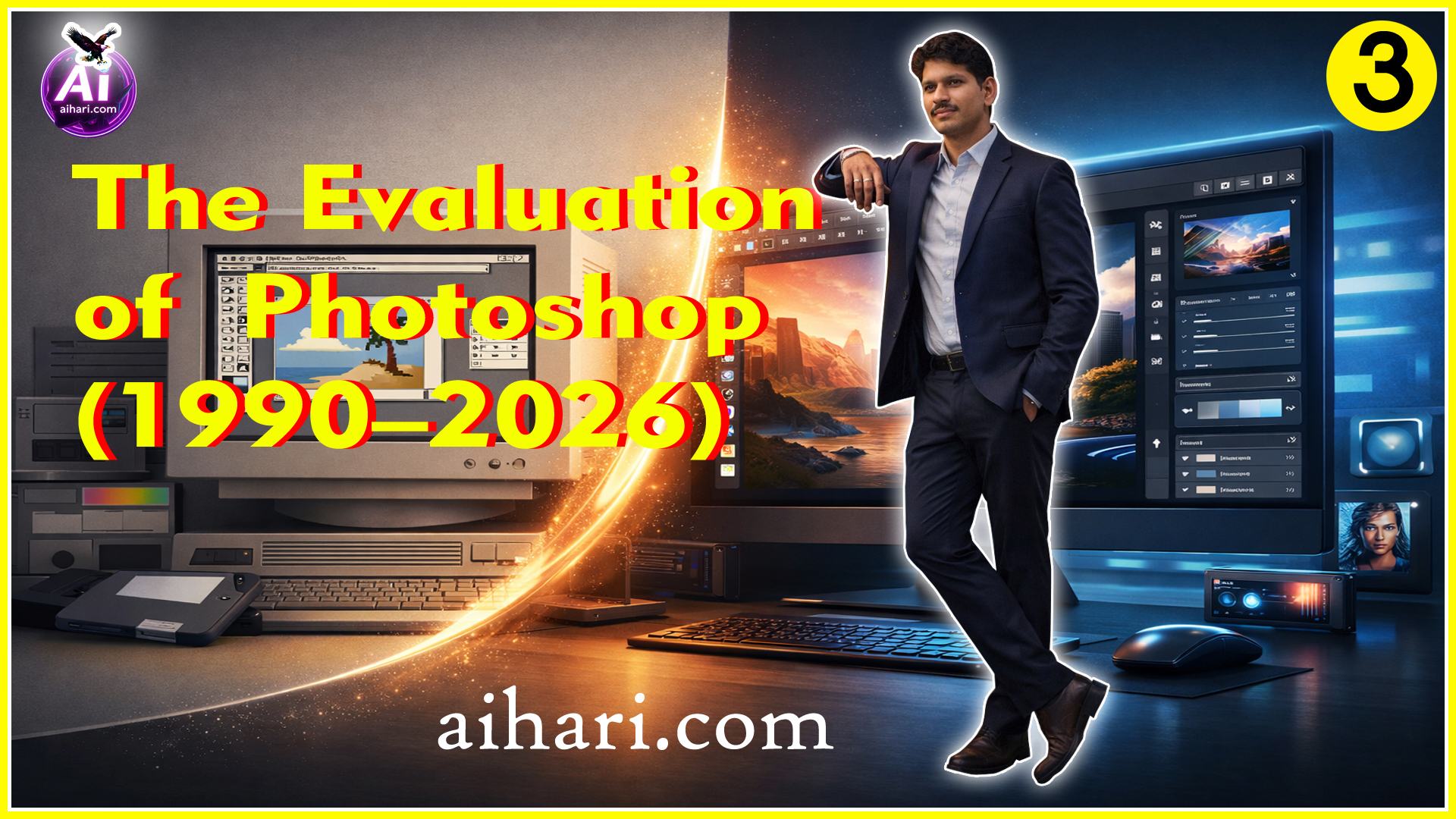
From simple photo editing software, Photoshop developed and evolved into a creative world. By 2026, it’s not just a tool—it’s a creative, intelligent partner.
Adobe Photoshop 2026 is an AI-powered, cloud-connected creative platform and more. PS 2026 focuses on speed, creativity, automation, realism, and more workflows across devices. The mobile version is also available now.
Photoshop 2026 features
AI-Powered Creativity
Photoshop 2026 uses artificial intelligence to understand intent. You describe, it creates. You imagine, it assists.
Real-Time Design Intelligence
The software now predicts your next move, suggests improvements, and fixes problems before you notice them.
Photoshop 2026 Interface
Workspace Overview
The interface is cleaner, smarter, and adaptive. Panels rearrange themselves based on what you’re doing.
Customization for Speed and Comfort
Workspaces can be customized for photography, design, social media, or AI generation—saving time and mental energy.
Core Photoshop Fundamentals
Layers
Layers work like transparent sheets stacked on top of each other. Master layers, and you master Photoshop 2026.
Selections and Masks
Selections isolate areas. Masks hide or reveal without deleting. masks is digital erasers with in the layer and memory.
Here the brush tool is used to hide and reveal the image; black hides and white shows.
Brushes and Tools
Brushes in 2026 feel natural, responding to pressure, tilt, and speed. Tools adapt based on context.
Color Theory in Photoshop
Color modes, gradients, and harmony tools help you create emotionally powerful visuals.
Smart Objects and Non-Destructive Editing
Why Non-Destructive Editing Matters
Mistakes are part of creativity. Non-destructive editing lets you experiment freely without fear.
Smart Filters Explained
Apply effects, adjust them later, or remove them entirely—without harming the original image.
AI and Automation in Photoshop 2026
Generative Fill and Expand
Need more background? Just ask. Photoshop generates realistic content instantly.
Context-Aware Editing
Remove objects, fix lighting, or enhance details automatically while keeping everything natural.
Photo Editing Essentials
Retouching and Restoration
Photoshop 2026 makes skin retouching subtle and realistic. Old photos can be restored with a single click.
Lighting, Shadows, and Depth
Advanced lighting tools add cinematic depth, making flat images feel alive.
Graphic Design Fundamentals
Typography Basics
Smart typography tools suggest font pairings and spacing for perfect readability.
Layout and Composition
Grids, guides, and AI composition tools help balance visuals effortlessly.
Photoshop for Web and Social Media
Optimizing Images for Speed
Automatic compression ensures fast loading without losing quality.
Designing for Multiple Platforms
One design adapts instantly for Instagram, YouTube, websites, and ads.
3D, Motion, and Mixed Media
Lightweight 3D Features
Basic 3D elements add depth without overwhelming beginners.
Motion Graphics Integration
Subtle animations bring static designs to life.
Workflow Tips for 2026
Cloud-Based Collaboration
Work with teams in real time from anywhere in the world.
Shortcuts and Productivity Hacks
AI-driven shortcuts reduce repetitive tasks, letting you focus on creativity.
Learning Photoshop in 2026
Best Practices for Beginners
Start with fundamentals: layers, masks, and color. Let AI assist, not replace learning.
Staying Future-Ready
Keep experimenting. Photoshop evolves, and so should you.
The Future of Visual Creativity
Where Photoshop Is Heading Next
Photoshop is moving toward thought-driven creation—where imagination becomes reality faster than ever.
Conclusion
From the birth of Earth to the digital landscapes of 2026, creativity has always been about expression. Photoshop 2026 stands as the latest chapter in humanity’s visual journey—a tool that blends natural design principles with artificial intelligence. Mastering its fundamentals isn’t just about learning software; it’s about continuing a creative legacy that began billions of years ago.
FAQs
1. Is Photoshop 2026 suitable for beginners?
Yes, AI assistance and smart tools make it easier than ever to start.
2. Do I still need to learn fundamentals if AI does everything?
Absolutely. Fundamentals help you control AI instead of relying on it blindly.
3. What is the most important feature to learn first?
Layers and masks—they are the foundation of everything.
4. Can Photoshop 2026 replace professional designers?
No. It enhances creativity but still needs human vision and judgment.
5. Is Photoshop 2026 future-proof?
It’s designed to evolve continuously, keeping creators ready for what’s next.